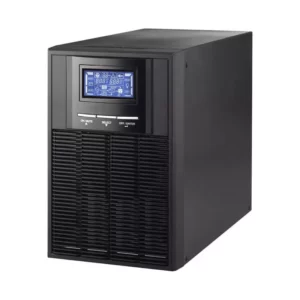
Features
Online Double-Conversion Technology
Online double-conversion technology provides stable, clean, and continuous power protection for sensitive and critical equipment.
Unity Output Power Factor
Output power factor 1 delivers more usable active power, helping maximize UPS capacity and support modern critical loads.
Modular Power Design
The modular architecture supports 20kW and 30kW power modules, making installation, maintenance, and future capacity expansion more flexible.
Cabinet Capacity up to 60kW or 90kW
The UPS cabinet supports up to 60kW or 90kW capacity depending on configuration, making it suitable for medium-size critical power applications.
High Efficiency Operation
High-efficiency design helps reduce energy consumption and supports lower operating costs in long-term operation.
Low Input Harmonic Distortion
Input THDi below 3% at full load helps reduce impact on upstream electrical systems and improves compatibility with facility power infrastructure.
Wide Input Voltage Range
The UPS supports a wide input voltage range, helping maintain stable operation in environments with unstable mains power.
Flexible Battery Configuration
Battery numbers can be adjusted according to backup time, system voltage, and project requirements, supporting different runtime needs.
User-Adjustable Charging Current
Charging current is user-adjustable, allowing battery charging to be configured according to battery capacity and project design.
Built-In Maintenance Bypass
The built-in maintenance bypass switch allows easier maintenance while helping keep critical loads powered when properly configured.
1+1 Cabinet Parallel Support
The UPS supports 1+1 cabinet parallel configuration, providing additional flexibility for redundancy or capacity expansion.
Strong Overload Capability
The UPS supports temporary overload conditions, helping maintain stable operation during short load impact events.
Graphic 5.7-Inch LCD Display
The graphic LCD display provides clear system information for monitoring, operation, and configuration.
USB, RS-232, and Optional SNMP Monitoring
USB and RS-232 communication are supported, with optional SNMP for network-based power management through monitoring software or web browser.
Front-Access Service Design
Front-access design helps simplify installation, inspection, and maintenance in equipment rooms with limited space.
Specifications
| MODEL | 15U-60 | 15U-90 |
| PHASE | 3-phase in/3-phase out | |
| MAX CABINET CAPACITY* | 60KW | 90KW |
| BATTERY TYPE | External Battery | |
| ONE POWER MODULE CAPACITY | 20KVA / 20KW | 30KVA / 30KW |
| MAX. POWER MODULE NO. | 3 | |
| INPUT | ||
| Nominal Voltage | 3 x 380VAC/400VAC/415VAC (3Ph+N) | |
| Voltage Range | 305 ~ 478 VAC at 70% – 100% load; 208 ~ 478 VAC for <70% load | |
| Nominal Frequency | 50/60Hz (Auto sensing) | |
| Frequency Range | 40Hz ~70Hz | |
| Power Factor | > 0.99 at 100% load, >0.98 at 50% load | |
| Harmonic Distortion (THDi) | < 3% @ 100% load | |
| OUTPUT | ||
| Nominal Voltage | 3 x 380VAC/400VAC/415VAC (3Ph+N) | |
| Voltage Regulation (Steady state) | ≦ ± 1% Typical (balanced load); ≦ ± 2% Typical (unbalanced load) | |
| Nominal Frequency | 50/60Hz | |
| Frequency Range (Synchronized) | 46Hz ~ 54Hz or 56Hz ~ 64Hz | |
| Overload Capability | 1 hour for 110%, 10 mins for 125%, 1 min for 150% and 200ms for >150% | |
| Harmonic Distortion | ≦ 2% THD (Linear Load) ; ≦ 4% THD (Non-linear Load) | |
| Efficiency | Up to 94.5% | |
| BATTERY / CHARGER | ||
| Nominal Voltage | +/- 216V (12V x 36 Pcs) | |
| Maximum Voltage | +/- 240V (12V x 40 Pcs) | |
| Minimum Voltage | +/- 192V (12V x 32 Pcs) | |
| Float Charging Voltage | 2.25V/Cell | |
| Boost Charging Voltage | 2.35V/Cell | |
| Temperature Compensation | Yes | |
| Maximum Charging Current | 6A (User-adjustable) | 8A (User-adjustable) |
| PHYSICAL | ||
| Cabinet Dimension (D x W x H) mm | 1000 x 515 x 763 | |
| Net Weight (kg) | 182 | 183.5 |
| ENVIRONMENT | ||
| Operating Temperature | 0 ~ 40°C | |
| Relative Humidity | 0 ~ 95% non-condensing | |
| Altitude | <1000m for Nominal power | |
| IP Protection | IP 20 | |
| MANAGEMENT | ||
| Smart RS-232 / USB | Supports Windows®2000/2003/XP/Vista/2008, Windows®7/8/10, Linux and MAC | |
| Optional SNMP | Power management from SNMP manager and web browser | |
| STANDARDS | ||
| Safety | IEC/EN 60950-1; IEC/EN 62040-1 | |
| EMC | IEC/EN 62040-2 Category C3 | |
| *When temperature is above 30℃ , the output power factor will be de-rated, 0.9 at 31℃ ~35℃ and 0.8 at 36℃ ~40℃ . | ||
| **If the UPS is installed or used in a placewhere the altitude is above than 1000m, the output power must be derated one percent per 100m. | ||
| Product specifications are subject to change without further notice. | ||
Applications
Data Centers
Provides scalable 3-phase backup power for servers, storage systems, network equipment, and critical IT infrastructure.
Server Rooms and Network Rooms
Suitable for medium-size server rooms, network cabinets, communication rooms, and enterprise IT environments.
Telecom Facilities
Supports telecom equipment, communication rooms, central offices, and network infrastructure requiring stable 3-phase power protection.
Industrial Control Systems
Helps protect PLC systems, SCADA platforms, industrial servers, monitoring systems, and control room equipment.
Healthcare Facilities
Suitable for healthcare IT rooms, diagnostic systems, laboratory equipment, and selected critical medical infrastructure.
Financial Institutions
Provides reliable backup power for bank IT rooms, payment systems, branch infrastructure, trading support systems, and financial data rooms.
Commercial Buildings
Supports centralized power protection for office IT rooms, security systems, communication equipment, and critical building infrastructure.
Emergency and Public Safety Facilities
Suitable for emergency operation centers, dispatch systems, communication rooms, surveillance systems, and mission-critical response infrastructure.
Frequently Asked Questions
What is this 3-phase modular online UPS used for?
This UPS is designed to provide scalable backup power and power protection for critical equipment in data centers, telecom rooms, industrial control rooms, healthcare facilities, financial institutions, and commercial infrastructure.
What capacity range does this UPS support?
This UPS supports cabinet capacities up to 60kW or 90kW, depending on the configuration and installed power modules.
What power module options are available?
The UPS supports 20kW and 30kW power modules, allowing flexible system configuration according to load capacity, redundancy requirements, and future expansion plans.
What is the advantage of output power factor 1?
Output power factor 1 means the UPS can deliver more usable active power. This helps improve system utilization and better support modern IT, telecom, and critical power loads.
Does this UPS support battery flexibility?
Yes. The battery configuration can be adjusted according to the required backup time, DC voltage design, battery quantity, and project requirements.
Does this UPS support parallel operation?
Yes. It supports 1+1 cabinet parallel operation, which can be used for redundancy or capacity expansion depending on the project design.
Does this UPS include maintenance bypass?
Yes. It includes a built-in maintenance bypass switch, which helps simplify maintenance and service operations while supporting continuous power to critical loads when properly configured.
What monitoring options are available?
The UPS supports USB and RS-232 communication, with optional SNMP monitoring for power management through monitoring software or a web browser.
Is this UPS suitable for data centers?
Yes. It is suitable for data centers, server rooms, network rooms, and critical IT environments that require scalable capacity, stable 3-phase output, high efficiency, and reliable backup power.
Is this UPS suitable for industrial applications?
Yes. It can be used in industrial control rooms and other industrial power protection applications, especially for control systems, monitoring equipment, industrial servers, and communication infrastructure. Final selection should consider load type, site environment, power quality, and backup time requirements.
What information is needed to choose the right configuration?
To recommend the right UPS configuration, the following information is usually required: load capacity, input/output voltage, phase requirement, backup time, redundancy requirement, battery configuration, installation environment, monitoring needs, and future expansion plan.