
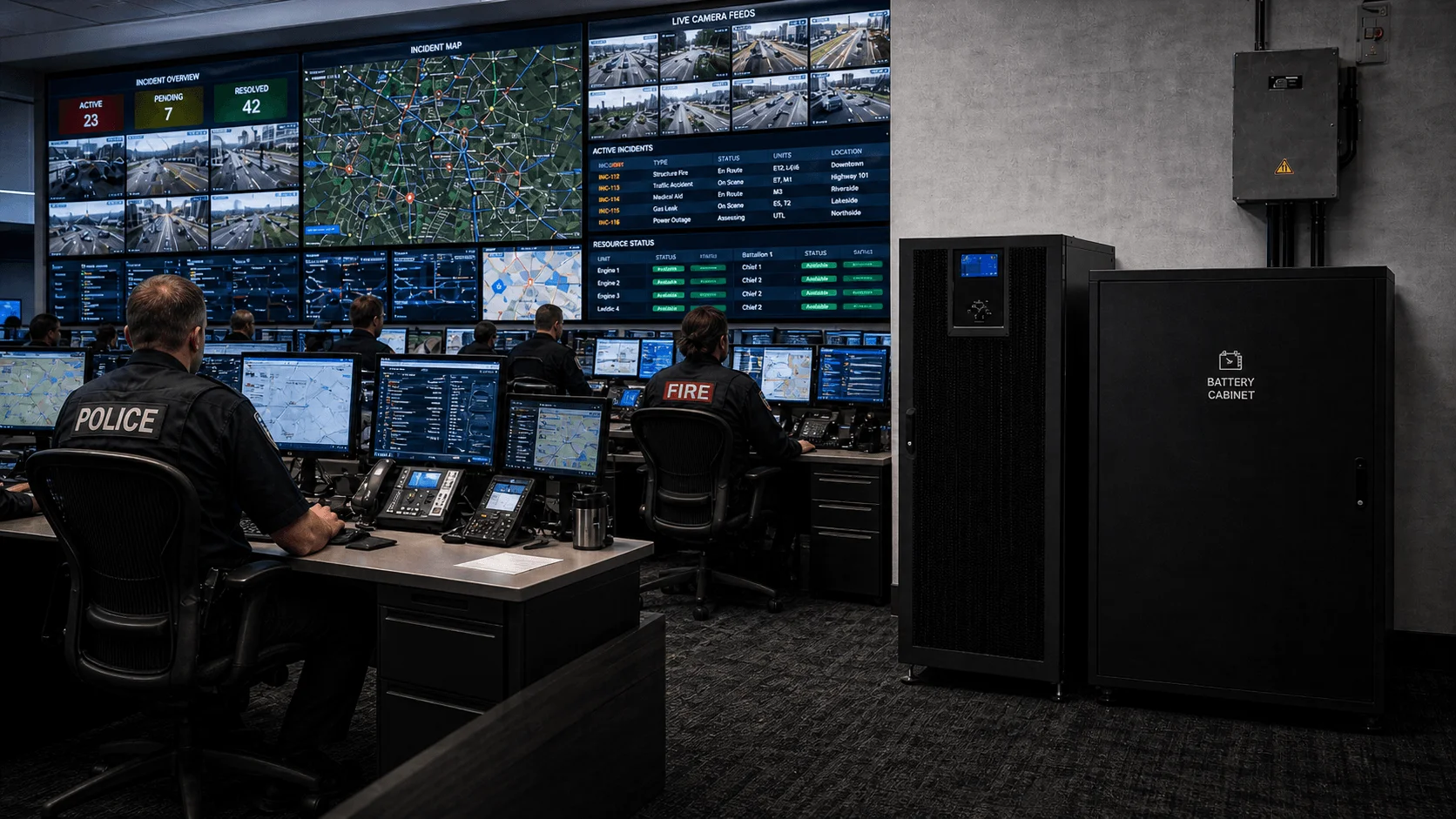
In emergency services and public safety, power continuity is not simply an operational requirement. It is a lifeline. Emergency communication centers, dispatch rooms, police stations, fire stations, ambulance services, emergency operations centers, public warning systems, surveillance networks, and critical response facilities must remain operational during power outages, natural disasters, grid failures, severe weather, infrastructure faults, and crisis events.
A public safety UPS system, or Uninterruptible Power Supply for emergency services, provides immediate backup power and power protection for mission-critical equipment. It helps maintain communication, support emergency coordination, protect sensitive electronics, and bridge the gap between utility power failure and long-duration backup sources such as generators or battery energy storage systems.
For emergency services, a UPS is not just a backup device. It is part of a wider resilience strategy designed to keep essential systems running when communities need them most.
Why UPS Systems Are Essential in Emergency Services and Public Safety
1. Maintaining Emergency Communication
Emergency response depends on reliable communication. Dispatchers, first responders, command centers, hospitals, government agencies, utility companies, and field teams must be able to communicate during emergencies.
UPS systems help protect:
- Emergency call centers
- Dispatch consoles
- Radio communication systems
- VoIP and IP communication systems
- Network switches and routers
- Public warning systems
- Satellite communication terminals
- Mobile command center equipment
- Emergency operations center workstations
When utility power fails, a properly sized UPS provides immediate backup power so communication systems can continue operating until power returns or a generator starts.
2. Supporting Emergency Operations Centers
Emergency Operations Centers, or EOCs, coordinate disaster response, resource allocation, evacuation planning, public communication, interagency cooperation, and recovery operations. These centers often depend on workstations, servers, video walls, radio systems, network equipment, communication consoles, monitoring systems, and emergency management software.
UPS systems help keep EOCs operational during:
- Grid outages
- Severe storms
- Floods
- Earthquakes
- Wildfires
- Public safety incidents
- Infrastructure failures
- Utility maintenance events
- Generator transfer periods
For emergency operations centers, UPS systems should be designed around critical loads, required backup time, redundancy, monitoring, and coordination with the facility’s broader emergency power plan.
3. Protecting Fire Stations, Police Stations, and EMS Facilities
Fire stations, police stations, ambulance bases, and rescue service facilities must remain ready even when the surrounding area loses power. These facilities rely on communication systems, alert systems, security equipment, access control, radio chargers, dispatch terminals, and IT networks.
UPS systems can support:
- Dispatch terminals
- Radio base stations
- Network cabinets
- Security systems
- Access control systems
- CCTV systems
- Alarm panels
- Emergency lighting controls
- Garage door control systems
- Radio and device charging stations
- Selected EMS support equipment
UPS systems are especially valuable for protecting critical low-to-medium power systems that must not shut down during the short transition between power failure and generator startup.
4. Protecting Public Safety Communications
Public safety communication networks may include radio systems, telecom equipment, fiber links, microwave transmission, routers, switches, repeaters, servers, and dispatch platforms. If these systems lose power, emergency calls, field coordination, and response management may be affected.
UPS systems support communication reliability by providing backup power for:
- Radio repeaters
- Communication servers
- Network routers
- Fiber transmission equipment
- Dispatch system servers
- Public alert control systems
- Recording and logging systems
- Communication monitoring equipment
For remote communication sites, outdoor UPS systems, DC backup systems, solar hybrid systems, or generator-supported battery backup may be required.
5. Bridging the Gap Before Generators Start
In many public safety facilities, the UPS is not designed to power the whole building for many hours. Instead, it provides instant backup power while the generator starts and stabilizes.
A typical emergency power sequence may look like this:
- Utility power fails.
- UPS instantly supports critical equipment.
- Generator starts and stabilizes.
- Transfer equipment shifts critical loads to generator power.
- UPS continues to protect sensitive electronics from power disturbances.
This approach helps avoid communication failure, system reboot, data interruption, and delayed emergency response during the power transition.
Key UPS Application Scenarios in Emergency Services and Public Safety
Emergency Dispatch Centers
Dispatch centers are among the most important UPS application scenarios in public safety. They manage emergency calls, radio communication, incident assignment, location tracking, responder coordination, and real-time decision support.
Recommended UPS focus:
- Online double-conversion UPS
- Redundant UPS architecture
- Backup for dispatch consoles and servers
- Backup for network switches and routers
- Radio system support
- Generator compatibility
- Remote monitoring
- Preventive maintenance plan
For dispatch centers, the UPS system should be designed as part of a high-availability infrastructure, not as a simple office backup device.
Emergency Operations Centers
EOCs require reliable power for command workstations, communication systems, displays, video conferencing, servers, and emergency management platforms.
Recommended UPS focus:
- Three-phase online UPS for larger rooms
- Rack-mounted UPS for network cabinets
- External battery cabinets if longer runtime is required
- N+1 redundancy for critical systems
- Monitoring and alarm integration
- Coordination with building generator or long-duration backup source
Fire Stations
Fire stations need reliable power for response readiness, communication, alarm systems, access control, security, and selected facility control systems.
Recommended UPS focus:
- UPS for communication and dispatch equipment
- Backup for network cabinets and radio systems
- UPS for alarm and access control systems
- Short runtime for generator bridging
- Longer runtime where no generator is available
- Easy maintenance and battery replacement
Police Stations and Public Safety Buildings
Police stations depend on communication, surveillance, access control, evidence systems, secure networks, dispatch workstations, and administrative systems.
Recommended UPS focus:
- Backup for security systems
- Backup for communication equipment
- UPS for servers and storage
- Rack-mounted UPS for IT rooms
- Redundant UPS for critical command areas
- Remote monitoring for multi-site management
Ambulance Services and EMS Facilities
EMS facilities require backup power for dispatch systems, communication devices, medical support equipment, charging stations, and administrative systems.
Recommended UPS focus:
- UPS for dispatch terminals
- Backup for communication equipment
- Backup for network and radio systems
- Support for charging handheld radios and mobile devices
- Compact UPS for local workstations
- Generator or battery system coordination
For medically sensitive equipment, UPS selection should follow equipment manufacturer instructions and applicable local healthcare or emergency service requirements.
Public Warning and Alert Systems
Public warning systems may include sirens, public address systems, emergency alert networks, control panels, communication nodes, and remote monitoring devices.
Recommended UPS focus:
- Compact UPS or DC backup system
- Outdoor or cabinet-compatible design
- Battery backup for control panels
- Surge protection
- Remote alarm function
- Long backup time where required
Outdoor warning systems should be selected according to site conditions such as temperature, humidity, dust, lightning exposure, and maintenance accessibility.
Mobile Command Centers
Mobile command vehicles and temporary emergency sites may require portable or compact UPS systems to protect communication, computing, monitoring, and coordination equipment.
Recommended UPS focus:
- Rugged or compact UPS design
- Lithium battery backup where appropriate
- Generator compatibility
- Shock and vibration considerations
- Easy deployment and transport
- Backup for radios, laptops, routers, screens, and communication devices
Disaster Shelters and Temporary Response Sites
Emergency shelters and temporary response centers may need backup power for communication, registration systems, routers, lighting controls, security systems, and selected medical support devices.
Recommended UPS focus:
- Portable UPS or compact online UPS
- Backup for routers, laptops, radios, and communication devices
- External battery options
- Generator or solar hybrid compatibility
- Simple operation by non-technical staff
Recommended UPS Types for Public Safety Applications
Online Double-Conversion UPS
An online UPS is recommended for critical emergency communication and IT systems because it provides stable output power and strong protection against outages, voltage fluctuations, surges, and frequency instability.
Best for:
- Dispatch centers
- Emergency operations centers
- Radio communication systems
- Public safety servers
- Network rooms
- Command centers
Rack-Mounted UPS
Rack-mounted UPS systems are suitable for network cabinets, server racks, radio rooms, and communication equipment.
Best for:
- IT cabinets
- Routers and switches
- Dispatch system servers
- Radio system equipment
- Surveillance servers
- Public safety network infrastructure
Three-Phase UPS
Three-phase UPS systems are suitable for larger public safety facilities, large dispatch centers, emergency operations centers, and centralized communication rooms.
Best for:
- Large EOCs
- Public safety buildings
- Central dispatch facilities
- Critical communication hubs
- Multi-agency response centers
Modular UPS
A modular UPS is suitable for critical facilities requiring scalability and redundancy. It allows power modules to be added as demand grows and can support N+1 redundancy.
Best for:
- Large emergency communication centers
- Public safety campuses
- Government emergency facilities
- Mission-critical data and communication rooms
- Facilities with future expansion plans
Outdoor UPS or DC Backup System
Outdoor public safety equipment may require weather-resistant backup power.
Best for:
- Siren control cabinets
- Public warning systems
- Remote radio repeaters
- Surveillance poles
- Emergency communication nodes
- Roadside monitoring systems
Outdoor UPS systems should consider enclosure protection, temperature range, ventilation, battery performance, surge protection, and remote alarm requirements.
Portable UPS or Mobile Power Backup
Portable UPS systems are useful for temporary emergency response, field operations, and mobile command centers.
Best for:
- Mobile command vehicles
- Temporary shelters
- Emergency field offices
- Disaster recovery operations
- Portable communication systems
How to Choose the Right UPS for Emergency Services and Public Safety
1. Identify Mission-Critical Loads
The first step is to identify which systems must remain powered during an outage.
Typical mission-critical loads include:
- Dispatch consoles
- Emergency call systems
- Radio base stations
- Network switches and routers
- Public safety servers
- Surveillance systems
- Access control systems
- Alarm systems
- Public warning control panels
- Emergency management workstations
- Communication recording systems
The UPS should be sized for critical loads, not for every device in the building.
2. Calculate UPS Capacity
UPS capacity should be based on actual equipment load.
Important data includes:
- Total load in W, kW, VA, or kVA
- Input and output voltage
- Single-phase or three-phase requirement
- Power factor
- Startup or peak load
- Future expansion margin
- Redundancy requirement
For emergency services, capacity margin is important because communication and response systems may expand over time.
3. Define Required Backup Runtime
Backup time depends on the emergency power strategy.
Common runtime options include:
- 5–10 minutes for generator bridging
- 15–30 minutes for dispatch and communication continuity
- 30–60 minutes for critical systems without immediate generator transfer
- Longer runtime with external battery cabinets
- Hybrid solutions for remote or disaster-prone locations
Generators or other long-duration backup systems provide extended operation, while UPS systems provide instant power and protection for sensitive electronics.
4. Coordinate UPS with Generators or Long-Duration Backup Systems
UPS and generators should be designed as a coordinated system.
Important factors include:
- Generator startup time
- Transfer system operation
- UPS input voltage tolerance
- UPS frequency tolerance
- Bypass design
- Load priority
- Fuel or long-duration energy planning
- Maintenance and testing procedures
Where generators are not available, larger battery systems, solar hybrid backup, or portable power systems may be considered depending on the site and application.
5. Design for Redundancy and Fault Tolerance
Public safety facilities should consider redundancy for critical systems.
Common architectures include:
- N: Basic UPS capacity
- N+1: One additional UPS unit or power module
- 2N: Two independent UPS systems and power paths
- Parallel redundant UPS: Multiple UPS systems sharing and backing up the load
- Hybrid backup: UPS + battery + generator + solar or mobile power
For dispatch centers, EOCs, and public safety communication hubs, N+1 or 2N designs may be appropriate depending on criticality, budget, and operational requirements.
6. Use Remote Monitoring and Alarm Integration
Public safety facilities often operate continuously. UPS monitoring helps facility managers and IT teams detect problems before failure occurs.
Recommended monitoring features include:
- Battery health monitoring
- Load percentage monitoring
- Runtime estimation
- Temperature monitoring
- Overload alarm
- Input/output voltage monitoring
- SNMP or network monitoring
- Dry contact alarm
- Event logs
- Remote diagnostics
- Battery replacement warning
UPS alarms should be integrated into facility monitoring, building management, or emergency operations workflows where possible.
7. Plan Regular Maintenance and Testing
A UPS system is only reliable if it is maintained. Batteries age, fans wear out, dust accumulates, and electronic components can degrade over time.
Recommended maintenance practices include:
- Battery inspection
- Runtime testing
- Load testing
- Alarm testing
- Firmware review
- Ventilation inspection
- Dust cleaning
- Bypass verification
- Battery replacement planning
- Generator transfer testing where applicable
For mission-critical facilities, UPS testing should be part of the broader emergency preparedness plan.
8. Consider Environment and Installation Conditions
Public safety UPS systems may be installed in dispatch rooms, equipment rooms, fire stations, outdoor cabinets, mobile command vehicles, or temporary shelters.
Important factors include:
- Indoor or outdoor installation
- Operating temperature range
- Dust and moisture protection
- Ventilation and cooling
- Space limitation
- Noise level
- Access for maintenance
- Cable routing
- Battery room requirements
- Seismic or vibration considerations
- Physical security
For outdoor or mobile applications, ruggedized design and environmental protection are especially important.
Typical UPS Solutions by Public Safety Application
Small Fire Station or Police Station
Recommended solution:
- 1kVA–6kVA online UPS
- Backup for router, switch, radio equipment, CCTV, access control, and dispatch workstation
- Internal battery or external battery pack
- Optional SNMP or dry contact monitoring
Emergency Dispatch Center
Recommended solution:
- 6kVA–40kVA online UPS
- Redundant UPS configuration
- External battery modules
- Generator or long-duration backup compatibility
- Backup for dispatch consoles, servers, network equipment, and radio systems
- Centralized monitoring
Emergency Operations Center
Recommended solution:
- 10kVA–80kVA online or three-phase UPS
- External battery cabinets
- N+1 redundancy if required
- Backup for command workstations, video wall, communication systems, and network equipment
- Monitoring and alarm integration
Public Safety Communication Hub
Recommended solution:
- 10kVA–200kVA+ online or modular UPS
- N+1 or 2N redundancy
- Battery monitoring system
- Generator integration where available
- Remote monitoring
- Preventive maintenance plan
Outdoor Warning or Remote Radio Site
Recommended solution:
- Outdoor UPS or DC backup system
- Weather-resistant cabinet
- Battery backup
- Surge protection
- Remote alarm
- Optional solar or generator support
Mobile Command Vehicle
Recommended solution:
- Compact online UPS or rugged UPS
- Lithium battery backup where appropriate
- Generator compatibility
- Backup for radios, laptops, routers, screens, and communication devices
- Easy deployment and maintenance
Purchasing Advice for Emergency Services UPS Projects
When purchasing UPS systems for emergency services and public safety facilities, buyers should not focus only on equipment price. The correct UPS solution should match mission-critical load requirements, response priorities, runtime needs, generator strategy, redundancy level, environmental conditions, maintenance capability, and applicable local codes.
Before requesting a quotation, prepare the following information:
- Facility type: dispatch center, fire station, police station, EOC, radio site, shelter, or mobile command center
- Equipment list and critical load level
- Total load in W, kW, VA, or kVA
- Input and output voltage
- Single-phase or three-phase requirement
- Required backup time
- Generator or long-duration backup availability
- Redundancy requirement
- Indoor or outdoor installation
- Environmental conditions
- Battery type preference
- Remote monitoring requirement
- Alarm integration requirement
- Maintenance access conditions
- Future expansion plan
- Applicable local electrical, fire, and safety requirements
A professional UPS supplier should be able to provide capacity calculation, battery runtime estimation, redundancy design, battery configuration, wiring guidance, monitoring options, installation suggestions, maintenance planning, and integration advice for generators or emergency power systems.
Conclusion
Emergency services and public safety operations depend on reliable power to protect lives, coordinate response, maintain communication, and keep critical facilities operational during crisis events. From dispatch centers and emergency operations centers to fire stations, police stations, ambulance services, public warning systems, and mobile command centers, UPS systems play a vital role in power resilience.
A well-designed public safety UPS solution provides immediate backup power, clean electrical output, voltage regulation, runtime support, remote monitoring, redundancy, and generator bridging. It helps prevent communication failure, system reboot, data interruption, and delayed emergency response.
For emergency managers, facility engineers, public safety agencies, system integrators, and government infrastructure buyers, selecting the right UPS system is not simply about backup power. It is about protecting mission continuity, responder coordination, public safety, and the lifelines communities depend on during emergencies.
Frequently Asked Questions
What is a public safety UPS system?
A public safety UPS system is an uninterruptible power supply designed to provide backup power and power protection for emergency services, dispatch centers, police stations, fire stations, emergency operations centers, public warning systems, and communication infrastructure.
It helps keep mission-critical systems running during power outages, voltage fluctuations, generator transfer, or emergency events.
Why do emergency services need UPS systems?
Emergency services need UPS systems to keep communication, dispatch, network, security, and response systems operational during power outages, generator transfer, voltage fluctuations, severe weather, or disasters.
For public safety facilities, reliable backup power is essential for maintaining emergency response coordination and protecting critical services.
What type of UPS is best for dispatch centers?
For dispatch centers, an online double-conversion UPS is usually recommended because it provides stable output power and strong protection for critical communication, server, and network systems.
For larger dispatch centers or emergency operations centers, rack-mounted UPS, three-phase UPS, or modular UPS systems may be used depending on load size, redundancy requirements, and backup time.
How long should a UPS support public safety equipment?
Backup time depends on the facility design and emergency power strategy. Many systems need 5–10 minutes for generator bridging, while critical dispatch, communication, or network systems may require 15–60 minutes or longer with external battery cabinets.
Remote sites, public warning systems, or facilities without generators may require longer backup time or hybrid backup power solutions.
Can UPS systems work with generators?
Yes. UPS systems commonly work with generators. The UPS provides immediate backup power when utility power fails, while the generator provides longer-duration backup after startup and stabilization.
This combination helps avoid communication failure, system reboot, and data interruption during the transfer from utility power to generator power.
Do fire stations and police stations need UPS systems?
Yes. Fire stations and police stations often use UPS systems to protect communication equipment, dispatch terminals, routers, switches, security systems, access control, CCTV, alarm systems, and emergency support devices.
UPS systems are especially useful for protecting low-to-medium power critical systems during short outages or generator transfer periods.
What information is needed to choose a UPS for emergency services?
To recommend the right public safety UPS solution, the following information is usually required: critical equipment list, total load, input/output voltage, phase requirement, required backup time, generator or long-duration backup availability, redundancy requirement, installation environment, monitoring needs, and applicable project or local safety requirements.
Need a Reliable UPS Solution for Your Public Safety Project?
Whether you are protecting an emergency dispatch center, fire station, police station, emergency operations center, public warning system, communication site, or mobile command unit, choosing the right UPS solution is essential for response continuity, communication reliability, and mission-critical power protection.
Share your equipment load, voltage, backup time, generator status, installation environment, monitoring needs, and redundancy requirements with us. Our team can help recommend the right online UPS, rack-mounted UPS, modular UPS, battery configuration, monitoring system, and public safety power protection solution for your project.