
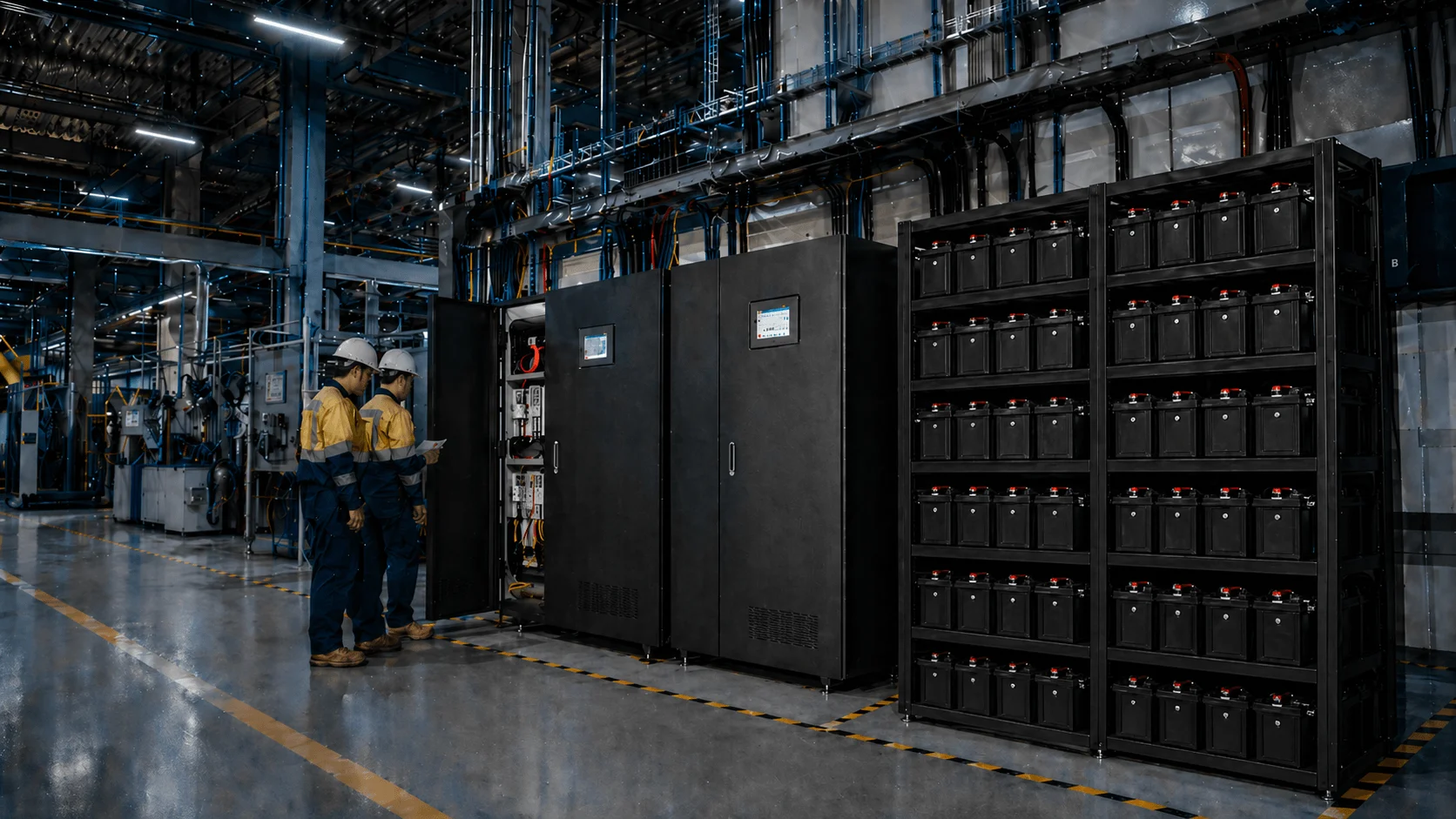
In industrial and manufacturing environments, power stability is directly connected to productivity, equipment reliability, product quality, worker safety, and operational efficiency. Modern factories depend on automated production lines, PLC control systems, CNC machines, robotic arms, variable frequency drives, sensors, SCADA platforms, industrial computers, data logging systems, safety controls, and communication networks.
When power is interrupted or unstable, the result can be production downtime, material waste, equipment damage, process instability, incomplete data records, or unsafe shutdown conditions.
An industrial UPS system, or Uninterruptible Power Supply for manufacturing facilities, provides backup power and power protection for critical industrial equipment. It helps maintain control system continuity, protect sensitive electronics, support safe shutdown procedures, and reduce losses caused by power disturbances.
As manufacturing moves toward automation, smart factories, robotics, industrial IoT, predictive maintenance, and data-driven production, reliable power protection becomes increasingly important. UPS systems are no longer used only for office computers or server rooms. In modern factories, they are part of a broader industrial power reliability strategy.
Why UPS Systems Are Essential in Industrial and Manufacturing Environments
1. Preventing Production Downtime
Production downtime can be extremely costly. A short power interruption may stop assembly lines, interrupt packaging systems, shut down conveyors, reset PLCs, damage work-in-progress materials, or cause machines to lose calibration.
UPS systems help protect critical production processes during:
- Utility power failure
- Voltage sag
- Voltage surge
- Short power interruption
- Generator transfer
- Switching events
- Poor power quality conditions
In many manufacturing facilities, UPS systems are not designed to power every heavy machine for many hours. Instead, they are usually used to protect critical control systems, industrial computers, communication devices, sensors, safety systems, and selected process equipment so that production can continue briefly, transfer to backup power, or shut down safely.
This distinction is important. For large motors, compressors, heaters, welding machines, pumps, and high-inrush industrial loads, a dedicated power solution may be required instead of a standard UPS.
2. Protecting PLCs, CNC Machines, Robotics, and Control Systems
Modern industrial equipment relies heavily on electronics. PLCs, HMIs, servo drives, CNC controllers, robot controllers, industrial PCs, vision systems, barcode scanners, and data acquisition systems can be sensitive to unstable power.
A properly selected industrial UPS can help protect:
- PLC control panels
- CNC machine controllers
- Robotic arm control systems
- SCADA servers and workstations
- Industrial PCs
- Sensors and measurement devices
- Production data loggers
- Network switches and gateways
- Safety control systems
- Packaging and labeling controllers
For automation-heavy factories, protecting the control layer is often more practical and valuable than attempting to back up all motor loads.
3. Maintaining Product Quality and Process Consistency
Power disturbances can affect product quality in many industries. In food processing, pharmaceutical production, electronics manufacturing, packaging, printing, automotive assembly, plastics processing, textile production, and precision machining, unstable power can lead to defective products, inconsistent output, interrupted batch records, or incomplete process cycles.
UPS systems support process stability by maintaining power to critical control and monitoring equipment. This helps reduce:
- Unplanned line stoppage
- Batch failure
- Material waste
- Process deviation
- Data loss
- Machine restart problems
- Product rework
- Quality inspection errors
In high-precision manufacturing, power quality is part of quality control. A stable power environment helps machines operate consistently and helps operators maintain reliable production standards.
4. Supporting Safe Shutdown Procedures
Some industrial processes cannot simply lose power without risk. Chemical processing, food production, coating lines, furnaces, automated warehouses, pharmaceutical equipment, and high-speed machinery may require controlled shutdown procedures to avoid product loss, equipment damage, or safety hazards.
UPS systems provide time for:
- PLC-controlled shutdown sequences
- Data saving and process logging
- Valve positioning
- Conveyor stop sequencing
- HMI alarm display
- Control system communication
- Safe shutdown of industrial computers
- Transfer to generator power
For safety-related systems, UPS design should always follow local electrical regulations, workplace safety requirements, machine manufacturer instructions, and professional engineering guidance.
5. Improving Power Quality for Sensitive Industrial Loads
Industrial facilities often contain nonlinear and high-disturbance loads, including VFDs, welding machines, compressors, motors, rectifiers, chargers, and large switching equipment. These loads can create voltage fluctuation, harmonics, transients, and electromagnetic interference.
UPS systems may be used together with other power quality solutions such as:
- Voltage stabilizers
- Surge protection devices
- Isolation transformers
- Harmonic filters
- Power factor correction systems
- Automatic voltage regulators
- Generator systems
In many industrial projects, a UPS alone is not enough. A complete power protection design may combine backup power, voltage regulation, surge protection, grounding improvement, harmonic control, and generator coordination.
Key UPS Application Scenarios in Industrial and Manufacturing Facilities
Automated Production Lines
Automated production lines use PLCs, HMIs, sensors, actuators, industrial PCs, conveyors, robots, and communication networks. A sudden power interruption may stop the entire process.
Recommended UPS focus:
- Online UPS for control panels
- Backup for PLCs, HMIs, sensors, and network switches
- Runtime for safe shutdown or generator transfer
- Industrial-grade enclosure if required
- Remote monitoring
- Maintenance bypass
For automated production lines, the UPS should be sized according to the control system load, not simply the size of the whole production line.
PLC and SCADA Control Systems
PLC and SCADA systems are the control center of many industrial operations. If they lose power, operators may lose process visibility and control.
Recommended UPS focus:
- Online double-conversion UPS
- Clean and stable output voltage
- Backup for PLC cabinets, SCADA servers, HMIs, and industrial network devices
- SNMP, Modbus, or dry contact alarm
- Safe shutdown software
- Redundant power supply design where needed
For factories with centralized control rooms, UPS protection for SCADA and industrial network systems is especially important.
CNC Machines and Precision Manufacturing
CNC machines and precision tools rely on controllers, servo systems, positioning logic, measurement systems, and industrial software. Power instability can cause machine errors, tool damage, or workpiece defects.
Recommended UPS focus:
- UPS for CNC controllers and control cabinets
- Voltage regulation
- Surge protection
- Short runtime for process completion or safe stop
- Coordination with machine manufacturer requirements
- Isolation transformer if needed
For large motor loads, the UPS must be carefully sized. In many cases, the UPS protects the controller and control circuit, while other power quality equipment protects the main machine power supply.
Robotics and Automated Assembly
Robotic arms, automated welding systems, pick-and-place machines, and assembly cells require stable control power. Power interruptions can stop robot motion, interrupt production sequences, or create recovery issues.
Recommended UPS focus:
- Backup for robot controllers
- PLC and safety system protection
- Industrial network protection
- Controlled stop capability
- Alarm and status monitoring
- Integration with safety circuits
For robotics applications, UPS selection should be coordinated with the robot manufacturer’s electrical requirements and the factory’s safety design.
Food, Beverage, and Pharmaceutical Production
Continuous processes and batch production require traceability, consistency, and controlled process conditions. Power interruptions can cause batch loss, contamination risk, failed records, or process deviations.
Recommended UPS focus:
- UPS for control systems and data logging
- Backup for monitoring and alarm systems
- Runtime for safe shutdown
- Protected enclosure if required
- Environmental consideration for temperature, humidity, and cleaning areas
- Coordination with facility safety requirements
In regulated or quality-sensitive production environments, protecting data logging and monitoring systems is often as important as protecting machinery.
Automotive Manufacturing
Automotive manufacturing depends on robotic assembly, welding, painting, conveyors, testing equipment, and production control systems. Downtime can affect output, quality, and delivery schedules.
Recommended UPS focus:
- Three-phase online UPS for key control systems
- UPS for robotic cells and PLC networks
- Backup for production data systems
- Generator transfer support
- Redundant UPS for critical production cells
- Remote monitoring and preventive maintenance
Automotive production often requires a layered approach: UPS for control systems, power quality equipment for sensitive machinery, and generators for longer-duration backup.
Semiconductor and Electronics Manufacturing
Electronics manufacturing often requires high precision, clean process control, stable environments, and reliable data systems.
Recommended UPS focus:
- High-quality online UPS
- Voltage regulation and low-distortion output
- Backup for control systems, inspection equipment, and data systems
- External battery cabinets for longer runtime
- Environmental monitoring integration
- Redundant design for critical processes
For sensitive testing, inspection, and production equipment, power quality should be evaluated carefully before selecting a UPS.
Industrial Safety and Security Systems
Industrial sites use many safety and security systems that must remain operational during power disturbances.
UPS systems can support:
- Fire alarm panels
- Gas detection systems
- Emergency communication systems
- Access control
- CCTV and NVR systems
- Emergency lighting controls
- Safety PLCs
- Alarm annunciators
- Control room systems
For safety-related systems, UPS design should follow local codes, project specifications, and professional engineering guidance.
Recommended UPS Types for Industrial Applications
Industrial Online UPS
An online double-conversion UPS is commonly recommended for critical industrial control systems because it provides continuous power conditioning and stable output.
Best for:
- PLC systems
- SCADA systems
- Industrial computers
- Automation control panels
- Laboratory and measurement equipment
- Sensitive production control loads
This type of UPS is suitable for equipment that requires clean, stable, and continuous power.
Three-Phase Industrial UPS
Three-phase UPS systems are suitable for larger manufacturing loads, production control rooms, industrial automation systems, and factory IT infrastructure.
Best for:
- Large control systems
- Production data centers
- Industrial automation rooms
- Packaging lines
- Automotive production areas
- Centralized manufacturing IT systems
For larger factories, three-phase UPS systems are often used with external battery cabinets, maintenance bypass, and remote monitoring.
Rack-Mounted UPS
Rack-mounted UPS systems are suitable for industrial IT cabinets, control room servers, network switches, and edge computing systems used in manufacturing.
Best for:
- Industrial network cabinets
- Edge computing systems
- Manufacturing execution systems
- SCADA servers
- Factory IT racks
Rack-mounted UPS systems are useful where industrial IT infrastructure is installed in standard equipment racks.
UPS with Isolation Transformer
In harsh industrial electrical environments, a UPS with an isolation transformer may be useful for applications requiring additional electrical isolation, noise reduction, or grounding support.
Best for:
- Harsh power environments
- Industrial control systems
- CNC control panels
- Measurement and testing equipment
- Facilities with grounding or electrical noise concerns
Whether an isolation transformer is needed should be determined according to site conditions and engineering requirements.
Modular UPS
A modular UPS is suitable for factories that need scalable capacity and redundancy. Power modules can be added as production expands.
Best for:
- Large manufacturing plants
- Industrial campuses
- Production data centers
- Automation-heavy factories
- Facilities requiring N+1 redundancy
Modular UPS systems are especially useful for factories planning phased expansion.
Rugged or Harsh-Environment UPS
Industrial sites may require UPS systems designed for high temperature, dust, vibration, humidity, corrosive atmosphere, or electrical noise.
Best for:
- Mining sites
- Oil and gas facilities
- Outdoor industrial cabinets
- Remote pumping stations
- Heavy industry
- Harsh manufacturing environments
In these environments, enclosure design, ventilation, temperature control, and maintenance access are just as important as UPS capacity.
How to Choose the Right UPS for Industrial and Manufacturing Facilities
1. Identify Critical Loads
The first step is to decide which systems need UPS protection. In many factories, it is not practical to back up all motors and production machines. The most important loads are usually the control, communication, monitoring, and safety systems.
Typical critical loads include:
- PLCs
- HMIs
- SCADA systems
- Industrial PCs
- CNC controllers
- Robot controllers
- Sensors and instruments
- Industrial network switches
- Safety systems
- Data logging systems
- Control room equipment
- Security and alarm systems
A clear list of critical loads helps avoid oversizing or misapplying the UPS.
2. Separate Control Loads from Power Loads
Industrial equipment often includes both control loads and power loads.
Control loads include:
- PLCs
- Controllers
- HMIs
- Industrial PCs
- Sensors
- Communication devices
- Safety circuits
Power loads include:
- Motors
- Heaters
- Compressors
- Pumps
- Drives
- Welding equipment
- Large mechanical systems
In many applications:
- UPS protects the control system.
- Voltage stabilizers protect against unstable input voltage.
- Surge protection devices protect against transients.
- Harmonic filters help reduce harmonic distortion.
- Generators support longer backup time.
- Isolation transformers improve electrical separation where needed.
This combined approach is more realistic and cost-effective than oversizing a UPS for every industrial load.
3. Calculate UPS Capacity
UPS capacity should be calculated based on actual load data.
Key information includes:
- Total load in W, kW, VA, or kVA
- Input and output voltage
- Single-phase or three-phase requirement
- Power factor
- Startup current or inrush current
- Motor or drive load characteristics
- Required runtime
- Future expansion margin
- Environmental derating
Industrial UPS selection should always consider peak load behavior and the type of connected equipment.
4. Define Backup Runtime
Backup time depends on the production process and backup power strategy.
Common runtime options include:
- 5–10 minutes for safe shutdown
- 10–20 minutes for control system continuity
- 15–30 minutes for generator bridging
- 30–60 minutes for unstable grid environments
- Longer runtime with external battery cabinets
For factories with generators, the UPS often provides bridging power while the generator starts and stabilizes. For sensitive process industries, longer runtime may be required to complete a batch or execute a safe shutdown.
5. Consider Power Quality Conditions
Before selecting a UPS, it is useful to evaluate the site’s power quality.
Important power quality factors include:
- Voltage sag
- Voltage surge
- Frequency instability
- Harmonic distortion
- Transients
- Neutral-ground issues
- Poor grounding
- Generator compatibility
- Electrical noise
- Load imbalance
A site power quality survey can help determine whether the project needs only a UPS or a broader power quality solution.
6. Plan Redundancy and Maintenance Bypass
For critical production lines, redundancy can reduce downtime risk.
Common designs include:
- N: Basic UPS capacity
- N+1: One additional UPS module or unit
- 2N: Two independent UPS systems
- Parallel redundant UPS: Multiple UPS units sharing and backing up the load
- Maintenance bypass: Allows service without shutting down critical loads
A maintenance bypass is especially important in factories where stopping production for UPS service is costly.
7. Use Remote Monitoring and Industrial Alarms
Industrial UPS systems should support monitoring and alarm integration.
Recommended features include:
- Battery health monitoring
- Load percentage monitoring
- Runtime estimation
- Input/output voltage monitoring
- Temperature monitoring
- Event logs
- SNMP monitoring
- Modbus communication
- Dry contact alarm
- Remote diagnostics
- Battery replacement warning
Monitoring data can be integrated into SCADA, BMS, EMS, or factory maintenance systems.
8. Consider Environmental and Installation Conditions
Industrial environments are often harsher than offices or data centers.
Important factors include:
- Dust
- Heat
- Humidity
- Vibration
- Oil mist
- Corrosive gases
- Poor ventilation
- Electrical noise
- Installation space
- Cable routing
- IP-rated enclosure requirement
- Battery room or cabinet requirements
A standard commercial UPS may not be suitable for harsh industrial environments unless properly protected.
Typical Industrial UPS Solutions by Application
PLC Control Cabinet
Recommended solution:
- 1kVA–3kVA online UPS
- Backup for PLC, HMI, sensors, relays, and communication devices
- Short runtime for safe shutdown or generator transfer
- Dry contact alarm, Modbus, or SNMP monitoring
CNC Machine Control System
Recommended solution:
- 3kVA–10kVA online UPS
- Backup for CNC controller and control circuit
- Voltage regulation
- Surge protection
- Optional isolation transformer
- Runtime for controlled stop
Automated Production Line
Recommended solution:
- 6kVA–40kVA online UPS
- Backup for PLC cabinets, HMIs, industrial PCs, network switches, and sensors
- Maintenance bypass
- Remote monitoring
- Generator compatibility
Robotics and Assembly Cell
Recommended solution:
- 3kVA–20kVA online UPS
- Backup for robot controller, PLC, safety controller, and communication system
- Alarm integration
- Controlled stop support
- Coordination with robot manufacturer requirements
Industrial Control Room
Recommended solution:
- 10kVA–80kVA online or three-phase UPS
- Backup for SCADA servers, operator stations, network equipment, and monitoring systems
- External battery cabinets
- Redundant configuration if needed
- Centralized monitoring
Large Manufacturing Plant
Recommended solution:
- 40kVA–500kVA+ three-phase or modular UPS
- N+1 redundancy
- External battery cabinets
- Generator integration
- Power quality analysis
- Preventive maintenance plan
- Integration with SCADA/BMS/EMS monitoring
Purchasing Advice for Industrial UPS Projects
When purchasing a UPS system for industrial and manufacturing applications, buyers should avoid selecting a UPS only by price or simple kVA rating. Industrial UPS projects require careful analysis of load type, process criticality, runtime, power quality, environment, safety requirements, and future expansion.
Before requesting a quotation, prepare the following information:
- Application type: PLC, CNC, robotics, production line, control room, or full facility
- Equipment list and critical load level
- Total load in W, kW, VA, or kVA
- Input and output voltage
- Single-phase or three-phase requirement
- Power factor
- Motor, drive, or inrush load details
- Required backup time
- Generator availability
- Site power quality issues
- Redundancy requirement
- Need for isolation transformer
- Need for voltage stabilizer or surge protection
- Installation environment
- Temperature, dust, humidity, and vibration conditions
- Monitoring communication requirement
- Maintenance bypass requirement
- Future expansion plan
- Local electrical and safety requirements
A professional UPS supplier should be able to provide capacity calculation, runtime estimation, battery configuration, wiring recommendations, power quality advice, enclosure suggestions, monitoring options, maintenance planning, and integration guidance with generators, stabilizers, or industrial control systems.
Conclusion
Industrial and manufacturing facilities depend on stable power to keep production lines running, protect automation equipment, maintain product quality, support safe shutdown procedures, and reduce costly downtime. As factories adopt robotics, PLC/SCADA systems, industrial IoT devices, smart manufacturing platforms, and data-driven production, reliable UPS systems are becoming increasingly important.
A well-designed industrial UPS solution protects critical control systems, industrial computers, sensors, communication networks, safety systems, and selected production equipment. It can also work together with generators, voltage regulators, surge protection devices, isolation transformers, and harmonic filters to create a stronger power protection strategy.
For plant managers, electrical engineers, system integrators, maintenance teams, OEM machine builders, and industrial buyers, selecting the right UPS system is not simply about backup power. It is about protecting production continuity, equipment investment, process stability, safety, and long-term manufacturing competitiveness.
Frequently Asked Questions
What is an industrial UPS system?
An industrial UPS system is an uninterruptible power supply designed to provide backup power and power protection for manufacturing equipment, industrial control systems, PLCs, SCADA systems, CNC machines, robotics, sensors, and factory communication networks.
It helps protect critical industrial loads from power outages, voltage fluctuations, surges, and other power quality problems.
Why do manufacturing facilities need UPS systems?
Manufacturing facilities need UPS systems to reduce production downtime, protect sensitive equipment, maintain process control, prevent data loss, support safe shutdown procedures, and reduce the risk of product defects caused by power interruptions.
A properly selected UPS can help keep control systems, monitoring equipment, and communication networks operational during short power events or generator transfer.
What type of UPS is best for industrial applications?
For critical industrial control systems, an online double-conversion UPS is usually recommended because it provides stable output power and strong protection against voltage fluctuations, outages, and power quality problems.
For larger manufacturing facilities, three-phase UPS or modular UPS systems may be more suitable, especially when higher capacity, redundancy, scalability, or centralized monitoring is required.
Can a UPS power large motors or heavy machinery?
It depends on the load size, startup current, and runtime requirement. In many industrial applications, the UPS is used to protect controllers, PLCs, HMIs, sensors, industrial PCs, and communication systems rather than powering large motors or heavy machinery for long periods.
Heavy power loads such as motors, compressors, pumps, heaters, welding machines, and large production equipment may require generators, voltage stabilizers, isolation transformers, or other specialized power solutions.
How long should an industrial UPS provide backup power?
Common backup times include 5–10 minutes for safe shutdown, 15–30 minutes for generator bridging, or longer runtime with external battery cabinets.
The correct runtime depends on the production process, critical load type, site power conditions, generator availability, and whether the UPS is intended for process continuity or controlled shutdown.
Do CNC machines need UPS systems?
CNC machines can benefit from UPS protection, especially for controllers, control panels, industrial computers, sensors, and communication devices.
UPS systems help reduce the risk of abnormal shutdown, data loss, process interruption, controller errors, and equipment restart problems caused by power disturbances. For large CNC machines, UPS selection should follow machine manufacturer requirements and actual load characteristics.
What information is needed to choose an industrial UPS?
To recommend the right industrial UPS solution, the following information is usually required: equipment list, critical load level, load capacity, input/output voltage, phase requirement, backup time, power factor, motor or inrush current details, installation environment, power quality issues, monitoring needs, redundancy requirements, and whether isolation transformer, stabilizer, or generator integration is needed.
Need a Reliable UPS Solution for Your Industrial Application?
Whether you are protecting a factory, production line, PLC system, SCADA platform, CNC equipment, robotics, industrial control room, or manufacturing IT infrastructure, choosing the right UPS solution is essential for production continuity, equipment protection, and process stability.
Share your equipment load, voltage, backup time, installation environment, power quality issues, monitoring needs, and redundancy requirements with us. Our team can help recommend the right industrial online UPS, three-phase UPS, modular UPS, battery configuration, isolation transformer, voltage stabilizer, and power protection solution for your manufacturing project.