Features
Low Frequency Double-Conversion Online Design
Low frequency double-conversion online design provides continuous power conditioning and stable output power for demanding 3-phase critical loads.
3-Phase Input / 3-Phase Output
The UPS supports 3-phase input and 3-phase output, making it suitable for industrial facilities, commercial power systems, data rooms, and critical infrastructure requiring three-phase power protection.
Wide Capacity Range
Available in 10kVA, 15kVA, 20kVA, 30kVA, and 40kVA, this UPS supports different critical power requirements from medium-size equipment rooms to larger 3-phase applications.
Pure Sine Wave Output
Pure sine wave output provides clean and stable power for servers, telecom systems, industrial equipment, medical IT systems, and sensitive electronic loads.
Zero Transfer Time
With online double-conversion operation, the UPS provides 0ms transfer time, helping maintain uninterrupted power during mains power disturbances.
Stable Output Voltage
Output voltage stability of ±1% under steady-state load helps ensure reliable operation for connected critical equipment.
Wide Input Voltage Support
The UPS supports 220/380/400/415/440VAC input options with wide voltage tolerance, improving adaptability in different power environments.
384VDC Battery System
The UPS uses a 384VDC battery system, supporting external VRLA battery configurations for backup power applications.
VRLA Battery Support
The UPS supports maintenance-free lead-acid battery systems, making it suitable for standard and long-runtime backup power configurations.
Strong Overload Capability
The UPS supports overload operation, including 110% for 30 minutes, 125% for 10 minutes, and 150% for 1 minute, helping improve reliability during temporary load impact conditions.
High System Efficiency
System efficiency up to 93% helps reduce energy loss and supports long-term operation in professional power environments.
Bypass Operation
Built-in bypass operation helps improve power continuity and supports system operation under specific overload or maintenance conditions.
Parallel and Redundancy Support
The UPS supports serial hot backup, redundancy, and parallel operation, making it suitable for applications requiring higher reliability or future capacity expansion.
Comprehensive Protection Functions
Protection functions include input protection, output protection, battery protection, temperature protection, and hardware fault protection to help improve overall system safety.
Dry Contact Interface
Dry contact interface provides alarm and status signal integration for external monitoring systems or facility management platforms.
EPO Interface
The Emergency Power Off interface allows fast shutdown in emergency situations when connected to the proper external control mechanism.
RS232 Communication
RS232 communication supports local monitoring, system communication, and basic UPS management.
LED and LCD Display
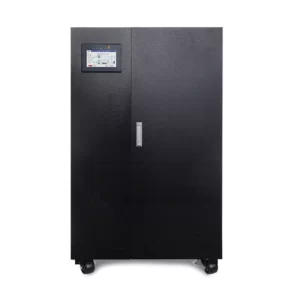
LED indicators show input, inverter, bypass, and battery status. The LCD display provides input/output voltage, frequency, load percentage, battery voltage, and internal status information.
Forced-Air Cooling
Forced-air cooling helps maintain stable operation and thermal control during continuous operation.
IP21 Protection
IP21 protection provides basic protection for indoor installation environments.
Specifications
| Model | 3C3-10K/L | 3C3-15K/L | 3C3-20K/L | 3C3-30K/L | 3C3-40K/L | |
| Capacity | 10KVA | 15KVA | 20KVA | 30KVA | 40KVA | |
| Nominal Capacity | 8KW | 12KW | 16KW | 24KW | 32KW | |
| Phase | 3 phase in 3 phase out | |||||
| Work Mode | Low frequency double conversion pure online | |||||
| Power Factor | >0.8 | |||||
| Display | LED | Including the state of input, inverter, bypass and battery | ||||
| LCD | Input & output voltage, frequency, battery voltage, present of loads, internal humidity | |||||
| Rectifier | Input Voltage | 220V/380V/400V/415V/440VAC ±30% 3 phase four wires input | ||||
| Input Frequency | 50/60hz ± 10% | |||||
| Wave Form | Pure sine wave | |||||
| Battery | Free-maintenance, Lead-acid battery | |||||
| Inverter | Nominal Voltage | 220/380/400/415/440VAC | ||||
| Output Voltage Stability | ±1% (steady-state load) ±5% (load fluctuations) | |||||
| Frequency Stability | 50/60hz load ± 0.5% | |||||
| Crest Factor | >3:1 | |||||
| THD | Pure sine wave <3% (linear load) | |||||
| Overload Capacity | 110% 300mins,125% 10mins, 150% 1mins | |||||
| Efficiency | 93% | |||||
| Bypass | Rated Voltage | For single phase L1: 220VAC (or 230VAC), For three phase: 380VAC(or 400VAC) | ||||
| Bypass Voltage Range | 220/380/415/440 ± 20% (10% 15% 20% adjustable) | |||||
| Rated Frequency | 50/60hz | |||||
| Bypass Frequency Range | ±20% (±1% to ±5% adjustable) | |||||
| Transfer Time | 0ms | |||||
| DC Voltage | 384VDC | |||||
| Protection | Input Protection | Overrun high or low input, overrun frequency | ||||
| Output Protection | Overcurrent, short circuit, low power factor | |||||
| Battery Protection | Over charge, over discharge protection | |||||
| Temperature Protection | Environmental overheating, inverter over-temperature protection | |||||
| Hardware Fault Protection | Auxiliary power anomaly, circuit breaker tripping, fuses disconnect and the power device over-current voltage protection | |||||
| System Parameter | Ambient Temperature | 0-40℃ | ||||
| Cooling Mode | forced ventilation | |||||
| Communication Interface | RS232, dry contact interface, EPO interface | |||||
| Redudancy & Parallel | Serial hot backup or redundancy & parallel | |||||
| Surge Capacity | (0/700µs,5KV) 8/20µs, 20KVA | |||||
| Protection Class | IP21 | |||||
| Security Capacity | Input and output electrical resistance to ground 3000VAC, leaking less than 3.5MA, insulation resistance>2Mw(500VDC) | |||||
| Noise dB | 58dB-70dB | |||||
| Dimension (mm) | 555*725*1220 | |||||
| N.W (kgs) | 223 | 245 | 260 | 336 | 351 | |
| G.W (kgs) | 280 | 298 | 317 | 393 | 408 | |
| * Product specifications are subject to change without further notice. | ||||||
Applications
Data Centers and Server Rooms
Provides stable 3-phase backup power for servers, storage systems, switches, firewalls, and critical IT infrastructure.
Industrial Facilities
Suitable for industrial control systems, automation equipment, PLC systems, monitoring platforms, and production support infrastructure.
Telecom Facilities
Supports telecom rooms, communication hubs, transmission systems, and network infrastructure requiring reliable three-phase power.
Medical and Healthcare Systems
Helps protect healthcare IT rooms, diagnostic support systems, laboratory equipment, and selected critical medical infrastructure.
Financial Institutions
Provides backup power for bank data rooms, payment systems, transaction platforms, security systems, and financial IT infrastructure.
Commercial Buildings
Suitable for centralized power protection in commercial buildings, office IT rooms, communication systems, and security infrastructure.
Emergency and Public Safety Facilities
Supports emergency operation centers, dispatch systems, communication rooms, surveillance systems, and mission-critical response infrastructure.
Education and Research Facilities
Protects campus IT rooms, laboratories, research platforms, testing equipment, and network infrastructure.
Long Backup Time Projects
External VRLA battery support and 384VDC battery configuration make it suitable for applications requiring extended backup time.
Frequently Asked Questions
What is this low frequency 3-phase online UPS used for?
This UPS is designed to provide reliable backup power and power protection for data centers, industrial systems, telecom facilities, healthcare infrastructure, financial systems, commercial buildings, and other critical 3-phase loads.
What does 3P/3P mean?
3P/3P means 3-phase input and 3-phase output. It is suitable for sites where both the power supply and protected loads require three-phase power.
What capacity range is available?
This UPS is available in 10kVA, 15kVA, 20kVA, 30kVA, and 40kVA models, with nominal output power from 8kW to 32kW.
What is the difference between low frequency UPS and high frequency UPS?
A low frequency UPS is generally designed for robust critical power protection and demanding electrical environments. It is often preferred for applications requiring stronger overload capability, better load adaptability, and long-term stability.
Does this UPS provide pure sine wave output?
Yes. It provides pure sine wave output, making it suitable for sensitive electronic equipment, industrial control systems, telecom equipment, medical IT systems, and critical infrastructure loads.
Does this UPS have zero transfer time?
Yes. As an online double-conversion UPS, it provides 0ms transfer time, helping protect critical loads from interruption during mains power disturbances.
What battery voltage does this UPS use?
This UPS uses a 384VDC battery system, typically configured with external VRLA batteries according to backup time requirements.
Does this UPS support external batteries?
Yes. It supports external maintenance-free lead-acid battery systems, making it suitable for long-runtime backup power applications.
Does this UPS support parallel operation?
Yes. It supports serial hot backup, redundancy, and parallel operation, depending on project configuration and system design.
What communication interfaces are available?
The UPS supports RS232 communication, dry contact interface, and EPO interface for monitoring, alarm integration, and emergency shutdown control.
What protection functions are included?
The UPS includes input protection, output protection, battery protection, temperature protection, hardware fault protection, short-circuit protection, and overload protection.
Is this UPS suitable for industrial applications?
Yes. It is suitable for industrial control rooms, automation systems, monitoring equipment, PLC systems, and other industrial environments requiring stable 3-phase backup power.
What information is needed to choose the right model?
To recommend the right model, the following information is usually required: load capacity, input/output voltage, backup time, battery configuration, installation environment, redundancy or parallel requirement, communication interface needs, and site power conditions.
How to choose within this range
This low-frequency range covers 10, 15, 20, 30 and 40kVA (nominal output 8kW to 32kW) for sites that want transformer-based robustness without jumping to the 60kVA class. It supports 220/380/400/415/440VAC input and output configurations, VRLA battery systems and a 384VDC battery configuration for long-backup projects, with ±1% steady-state output voltage stability and 0ms transfer time. If your load exceeds 40kVA, the Low Frequency 3-Phase Online UPS 60–120kVA continues the same design upward; if you prefer a lighter high-frequency design at this size, see the 3P/3P High Frequency Online UPS 10–20kVA. Related reading: UPS Installation and Commissioning — What to Do After You Buy.